Spain is at a decisive stage in meeting its decarbonisation and renewable energy deployment targets for 2030. However, the growth of new wind and solar projects no longer depends solely on the availability of energy resources or suitable land. Today, the main bottlenecks are territorial acceptance, administrative saturation, the shortage of viable grid connection points, and the need to better coordinate evacuation infrastructure.
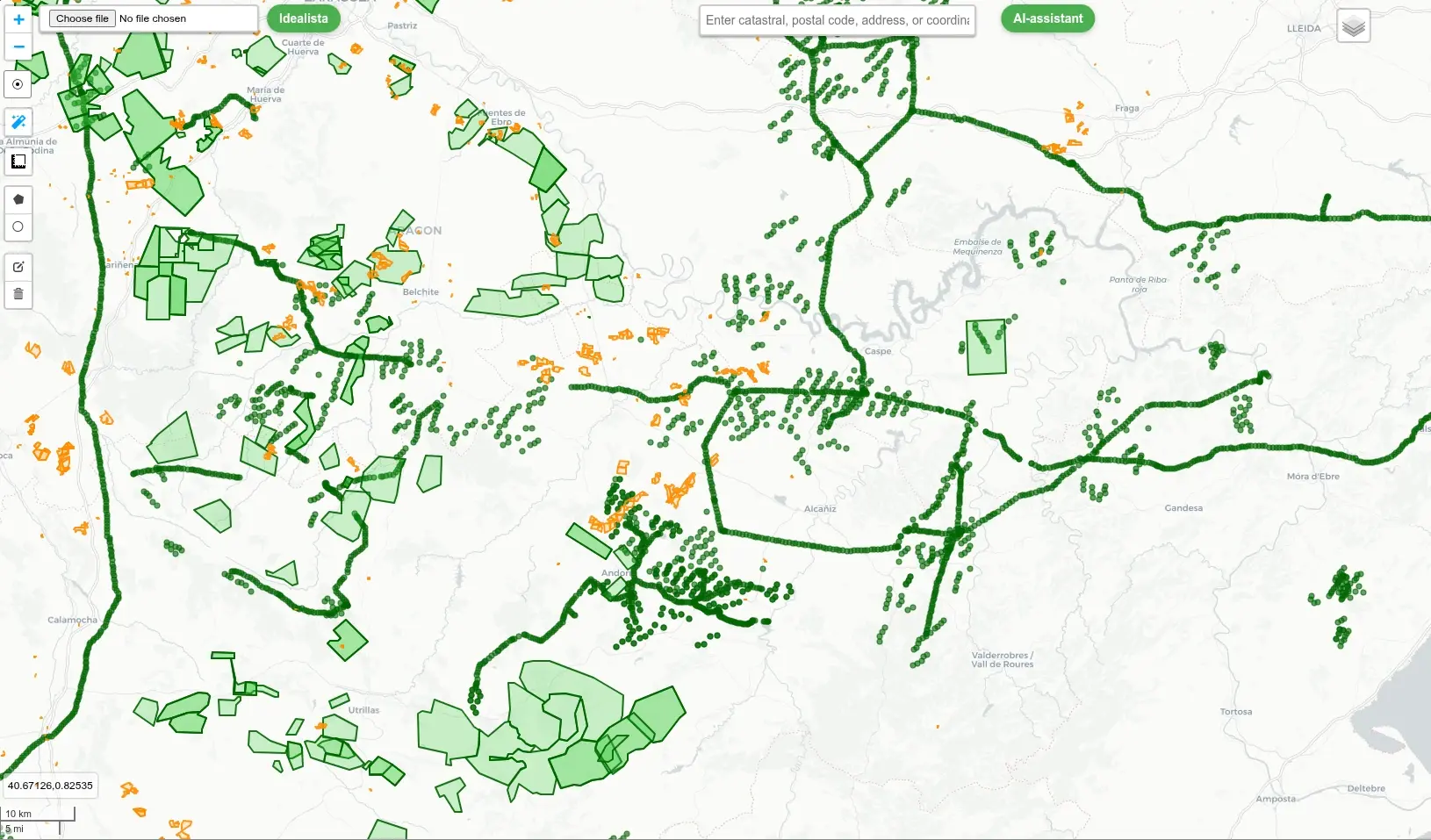
The analysis of wind projects currently under development shows the scale of the challenge. There are currently more than 30 GW of wind projects in the permitting process in Spain as of June 2026, distributed between regional and national procedures, with hundreds of wind farms at different administrative stages. These include projects in preliminary consultation, applications for prior administrative authorisation, positive environmental impact declarations, construction authorisations, as well as archived files or projects with a negative Environmental Impact Declaration. This reality shows that the territory is already highly conditioned by ongoing initiatives, rejected projects, environmentally sensitive areas, and grid limitations.
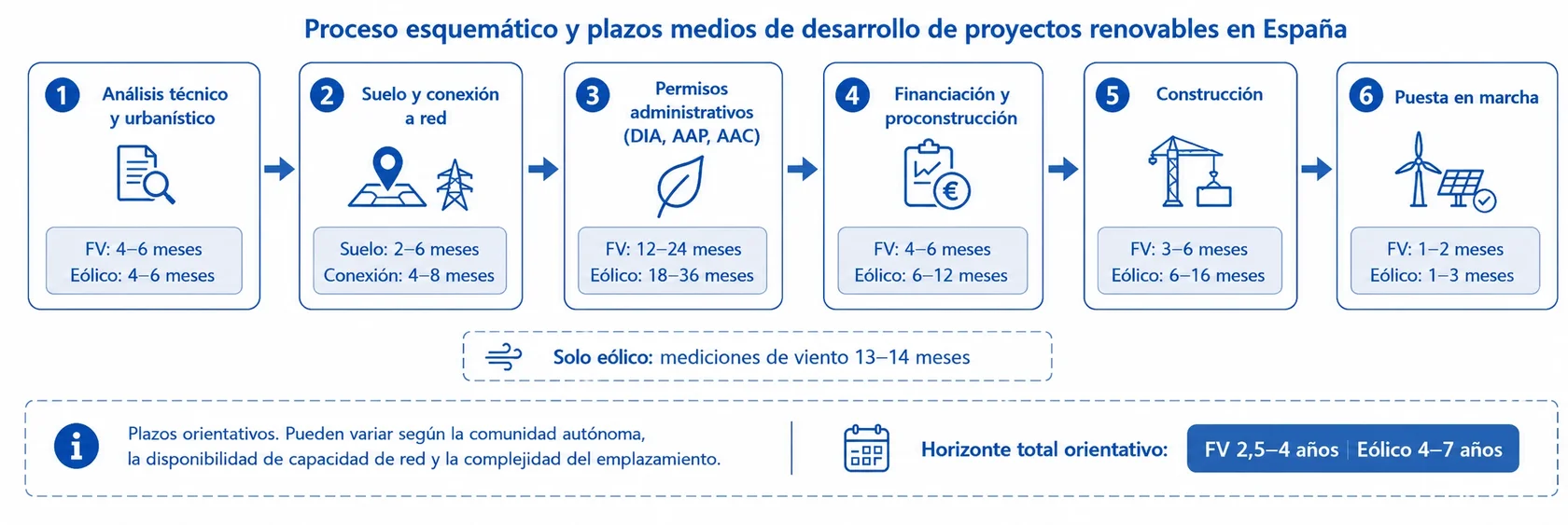
The development of a renewable energy project in Spain progresses gradually, from the initial technical and urban planning analysis to commissioning. First, the energy resource, land, urban planning compatibility, and grid connection are assessed. Then, the key administrative permits are processed, including the EID — Environmental Impact Declaration; the PAA — Prior Administrative Authorisation; and the CAA — Construction Administrative Authorisation. Once this stage has been completed, the project moves into financing, pre-construction, execution of works, and final grid connection tests. As an indicative timeframe, a photovoltaic plant usually requires between 2.5 and 4 years, while a wind farm may need between 4 and 7 years, especially due to wind measurements, greater environmental complexity, and longer permitting procedures.
At early development stages, this information makes it possible to quickly rule out areas where projects are already under development, zones with a history of administrative rejection, or territories with high levels of social conflict. This reduces analysis costs, avoids duplication, and helps focus efforts on locations with a higher probability of technical, environmental, and administrative viability.
This approach is also essential for grid connection planning. In a context of scarce available capacity, the ability to identify nearby projects opens the door to studying shared solutions: common evacuation lines, joint use of electrical corridors, coordinated substation upgrades, or hybrid infrastructure combining wind, solar, and storage. This vision can reduce environmental impacts, optimise investments, and improve the efficiency of the electricity system.
In short, the digitalisation of territorial analysis does not replace technical, environmental, or legal work, but it does make it possible to start that work better. It helps reduce uncertainty, prioritise resources, anticipate conflicts, and design projects that are better coordinated with the territory and the electricity grid. In an increasingly competitive market, this capability can make the difference between a viable opportunity and a project blocked from its earliest stages.
Discover new areas with renewable potential
At Terra Eólica, we are opening pilot access to our platform for the search and preliminary assessment of sites for wind and solar projects in Spain.
Whether you are a developer, investor, landowner, or company involved in renewable energy development, we invite you to take part in the pilot phase and see how an integrated view of the territory, the grid, and projects under development can accelerate the identification of new opportunities.